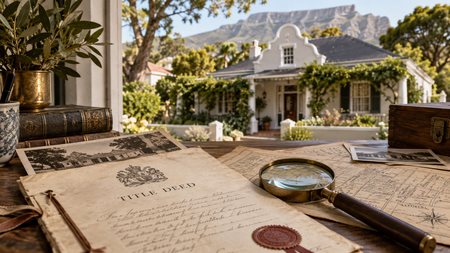
You may have heard the saying, “if only these walls could talk”. Most homeowners know when they bought their property, what they paid for it and, perhaps, who lived there before them. Few, however, know the full story of the land on which their home stands.
Who originally owned or built it? Was the property once part of a much larger farm? When was the erf created? Was the house built on an empty plot, or did another building stand there before it? Did anyone notable once live there?
If you have ever wondered about your property's past, Heritage Day is the perfect excuse to become a property detective and see how far back you can trace its history.
Start with the title deed
The logical starting point is the property's title deed.
A title deed is more than proof of ownership. South Africa's Deeds Registry maintains the country's property register and holds information relating to registered property owners, transfers, purchase prices, servitudes, restrictive conditions, mortgage bonds and other registered documents affecting a property.
You can access information through the official Deeds Registry either by visiting a Deeds Office or using its online services.
Option 1: Visit a Deeds Office
You can visit any Deeds Office; you do not necessarily have to go to the office where your property is registered. At the information desk, ask to conduct a property search. An official will explain the process and provide the relevant form. A prescribed fee applies to searches and copies of documents.
You will need the property's erf number and township name, rather than simply its street address. For agricultural property, you will need the farm name and number. For sectional-title property, you will need the section and scheme name.
It is also useful to have the registered owner's full name and, where available, identity number or date of birth.
The Deeds Registry is a public register, meaning property information can be accessed subject to the prescribed search procedures and fees.
Depending on what is registered against the property, you may be able to obtain information or copies relating to:
- registered owners;
- previous property transactions;
- purchase prices;
- servitudes;
- interdicts;
- registered contracts;
- mortgage bonds;
- sectional-title plans and rules; and
- other registered documents affecting the property.
Option 2: Search online through DeedsWeb
If you would rather conduct your research online, DeedsWeb provides electronic access to property-registration information, as well as PDF copies of scanned and microfilmed deeds and documents.
Depending on the records available, this can reveal details such as registered ownership, transfer dates, purchase prices, mortgage bond information and other registered information relating to the property.
To use the service, you need to register as a user on the official DeedsWeb platform.
Under the 2026 Deeds Registries regulations, registering as a DeedsWeb user carries a R229 non-refundable administration fee, while the subscription fee is R19 per month. Additional fees apply to individual searches, deeds, documents and other services.
Because Deeds Registry fees are amended periodically, always check the latest official fee schedule before conducting an extensive historical search.
What should you actually ask for?
Start by asking for the registration and transfer history of the property, then investigate the documents referenced in the current title deed.
The key is to work backwards:
You → previous owner → earlier owner → earlier owner → original registration.
A current title deed may refer to an earlier deed number. Finding that document may reveal another earlier deed, allowing you to follow the property's registered history further back in time.
This is where the process becomes a genuine property investigation rather than simply obtaining a document confirming who owns the house today.
Keep in mind that a deed search provides the property's registered history. It may show when ownership changed, but it will not necessarily tell you:
- who physically occupied the property;
- what stood on the land before the current house;
- why the original house was built;
- whether an earlier building was demolished;
- what the property looked like decades ago;
- how the surrounding neighbourhood changed; or
- what happened to people who previously occupied the land.
For that, you will need to broaden your investigation.
What you need before starting your property history search
Gather as much of the following information as possible before beginning:
- Erf number – this can usually be found on your municipal account.
- Township or suburb name.
- Farm name and number, if applicable.
- Section and sectional-title scheme name, if applicable.
- Current owner's full name.
- Previous owner's name, if known.
Build a property ownership timeline
Once you have the basic information, work through the records methodically rather than collecting documents without recording what they reveal.
- Search the Deeds Registry or DeedsWeb.
- Obtain the current deed.
- Note every earlier deed number referenced.
- Search for those earlier deeds.
- Record each owner, transfer date and purchase price you find.
- Note any servitudes and restrictive conditions.
- Follow references to earlier registered documents.
- Build a chronological ownership timeline.
A simple spreadsheet can make this much easier. Create columns for the owner's name, transfer date, purchase price, deed number and any unusual conditions or references that may require further investigation.
Find out what the land looked like before your home existed
This is where the investigation becomes particularly interesting.
Once you have traced the registered ownership, try to establish what the land looked like before the current neighbourhood existed.
Historic maps available through resources such as Old Maps Online may help you investigate:
- the original property boundaries;
- whether the property once formed part of a farm or larger piece of land;
- when surrounding erven were created;
- whether today's roads existed at the time;
- where rivers, streams or railway lines once ran;
- how the surrounding land was divided; and
- whether the property was later subdivided or consolidated.
Historic aerial photographs can be even more revealing. A photograph taken several decades ago could show fields, orchards, smallholdings or vacant land where rows of houses stand today.
Investigate the history of the house itself
The land and the building do not necessarily share the same history. Once you understand the property's ownership, investigate when the current house appeared and how it changed over time.
Contact the relevant municipality's development planning or building-control department and ask whether historical building or planning records are available for the property. Depending on the municipality and the age of the records, these may include approved building plans, zoning information, planning records and previous applications.
If records are available, compare them with the house as it stands today. You could discover that:
- the original house was considerably smaller;
- the property was extended at a later date;
- a garage was converted into living space;
- an outbuilding predates the main house;
- the property was previously used for something other than residential purposes;
- the current house replaced an earlier structure; or
- a subdivision created the property you own today.
Ask long-standing neighbours and local estate agents
Official records only tell part of the story. Long-standing residents can sometimes fill in details that will never appear on a title deed or municipal plan.
If you know someone who has lived in the neighbourhood for 40 or 50 years, ask what they remember about the property and surrounding area. They may recall previous owners, renovations, demolished houses, old businesses or what the neighbourhood looked like before it was developed.
These conversations can lead your investigation in unexpected directions, but remember that memories and neighbourhood stories are not always accurate. Where possible, use them as clues and look for documents, photographs, newspaper reports or archival records that can verify the story.
A local estate agent who has worked in the area for many years may also have valuable knowledge about older properties, subdivisions and the development of the neighbourhood.
Look beyond the property itself
Some homes develop stories and legends of their own – from famous former residents to tales of haunted houses. Finding out what actually happened may require you to search historical newspapers, archives, old photographs and local-history resources.
It can also be worthwhile researching the wider history of the area. Who lived on the land before the suburb existed? How did the area get its name? Were there farms, settlements, industries, transport routes or significant historical events nearby?
Understanding the story of the neighbourhood can provide important context for the story of your own property.
Turn your research into the story of your home
As you uncover information, photographs and documents, organise them into a simple timeline. What begins as a property search could ultimately become a fascinating record for future owners and generations of your family.
Takeaway: Heritage Day celebrates South Africa's diverse cultures, traditions, languages and history, as well as the stories passed down through generations. This year, while gathering around the braai, you might have a new story to tell – the story of the land beneath your feet and the home built upon it.