We spend enormous amounts of money on the space we live in but rarely ask whether our homes are designed around our ‘mental wellness’. Yael Geffen believes that needs to change.
A home is usually considered in very physical terms: how many bedrooms it has, how big the garden is, whether there is a braai area, the quality of the kitchen and, ultimately, what it is worth. But there is another question homeowners should be asking: How does this property make me feel, and can it help me heal?
Yael Geffen, CEO of Lew Geffen Sotheby’s International Realty is a long-standing mental-health advocate who has spoken publicly about living with a mental health condition, which she describes as a “brilliant burden”. She speaks about the crucial need for more awareness and empathy and the importance of removing the stigma around mental health.
Private Property asked Geffen how big a role the home plays in helping to alleviate mental health symptoms.
“A home is more than its floor plan. When we buy properties, we have a list of needs: number of bedrooms, size of the stand, suburb, etc. But we rarely view it from a wellbeing perspective, yet it really should be considered as part of a wider mental health support system.”
The home as a sanctuary
“Understand that mental health conditions can manifest at any point in a person’s life, and many go undiagnosed. For those like myself, there are up- and down-swings, and in a down-swing, you tend to isolate in your house, withdrawing from physical interactions,” she says. “This means your home needs to be a sanctuary, a place of healing.”
Reviewing how your home accommodates and facilitates your mental health is a vital first step, and this applies regardless of whether you live alone or with others. Geffen says this presents questions:
- Where can you go when you need to be completely alone?
- Where can you sit without a television, laptop or phone demanding your attention?
- Where can you see greenery?
- Where can you move your body?
- Where can you talk to someone without the rest of the household constantly interrupting?
- Where can you simply do nothing?
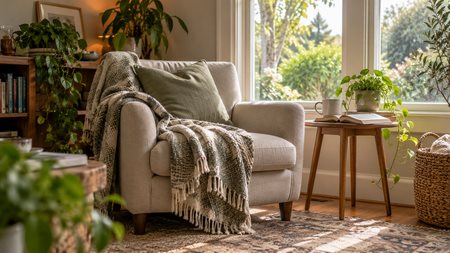
“Without a dedicated space, the mental health sufferer will be unable to heal effectively. This may require turning a rarely used spare bedroom into a quiet room, but if not possible, even an unused corner could accommodate a comfortable chair, or a portion of the garden allocated as a place to be alone,” says Geffen.
“The point is not to create a picture-perfect wellness retreat; it’s simply to find a peaceful niche where you can be left undisturbed.”
The mental-health square metre
This raises an interesting property dynamic that applies even if a person doesn’t suffer from a mental health challenge. We annually spend money on real estate we rarely use, like spare rooms that are used irregularly and tend to become clutter magnets.
We also have homes filled with spaces where everything happens: kitchens become homework depots, dining tables are also home offices, and open-plan design does not easily provide a space to switch off.
From a wellbeing perspective, finding a retreat space within these dynamics means finding a dedicated zone or a room where one can decompress. “It doesn’t need a therapeutic label. It simply needs to serve a purpose,” says Geffen.
Think in zones, not rooms
A home does not need to be large to provide healing and decompression zones. Geffen provides seven types of categories that apply for different states of mind:
- The transition zone: A place between work/the outside world and home life. Even a simple entrance bench where shoes come off and work bags are put away can create a physical boundary.
- The quiet zone: Somewhere with minimal noise and visual stimulation.
- The connection zone: A comfortable place for conversation, family meals, or simply being together without everyone staring at screens.
- The movement zone: A clear area for stretching, yoga, dancing, or exercise.
- The nature zone: A garden, balcony, courtyard, window seat, or even a collection of plants can provide a connection with nature, which is a proven decompressor.
- The creative zone: Somewhere for painting, writing, music, gardening, cooking, or another activity that absorbs attention without being about productivity.
- The retreat zone: A space where solitude is not interpreted as antisocial behaviour.
Support in the home
Geffen speaks about the importance of having a supportive wellness circle. “There are times that even at your lowest, you cannot escape from your responsibilities, be that as a parent, child, partner, employer or employee. This is tricky because you may not be able to isolate yourself or find solitude in the home. Another consideration is the damaging effects of isolating too much.
“This is why it is absolutely essential that those who care about you are made aware of your mental state of being at any given time,” says Geffen. “Their support should be adaptive to your cycles, allowing you to find the balance of both connection and solitude, and, most importantly, understanding and accepting that you may not be operating at your best.”
Buying property for mental health
Given the rise in awareness of mental health, the next generation of buyers’ questions may be different to those of today. Geffen says these are likely to be:
- Not: How many square metres am I getting? But: What are those square metres doing for me?
- Not: Does this house have a garden? But: Can I actually experience nature from inside it?
- Not: Is there a spare bedroom? But: Could that room give me somewhere to retreat?
- Not: Is this home impressive? But: Will this house uplift me when I’m down?
For Geffen, whose public advocacy has repeatedly focused on making mental-health conversations less taboo, the starting point is simple: “We should stop thinking that mental wellbeing belongs somewhere outside the front gate or door: It actually starts within.”